Therapy
What Happens in a Therapy Session? (A Honest 1st Timer’s Guide)
If you’re searching for what happens in a therapy session in India, you’re not alone. Most people spend weeks — sometimes months — thinking about booking a therapy session before they actually do it.
And one of the biggest reasons they wait? They don’t know what’s going to happen in the room.
Will the therapist ask them to lie on a couch? Will they be diagnosed with something? Will they have to talk about their childhood? Will they cry? (And if they do, will that be embarrassing?)
If any of this sounds familiar, this post is for you. Here’s exactly what happens in a therapy session in India — honestly, from the inside.
Before the session: the five minutes that feel the longest
Whether it’s online or in-person, the few minutes before your first session have a specific quality to them. A kind of quiet dread mixed with relief that you’ve finally done the thing.
You might feel nervous. You might suddenly wonder if your problem is “bad enough” to be here. (It is. We’ll come back to that another time.)
If it’s online, you’ll get a link. You’ll probably check your camera three times. That’s normal.
If it’s in-person, you’ll sit in a waiting space. You might fidget. Also normal.
What your therapist is doing in those same five minutes? Reviewing your intake form, settling into the space, and preparing to meet you — not a diagnosis, not a case, not a problem to fix. You.
What happens in a therapy session in India: You first
Here’s what surprises most first-timers: a therapy session in India, or anywhere, doesn’t begin with a test or an assessment or a dramatic reveal. It begins with a conversation.
Your therapist will probably ask something open — “What brings you here?” or “What’s been on your mind?” There’s no right answer. You can start anywhere.
You don’t need to have a prepared speech. You don’t need to be articulate or composed. You can say “I’m not sure where to start” — and that’s actually a perfectly good place to start.
In the first session, your therapist is listening for more than your words. They’re noticing how you tell your story. What you skip over. What you keep coming back to. What makes your voice go quiet. This isn’t analysis — it’s attention. The kind most of us rarely receive.
What your therapist is not doing
Let’s clear a few things up.
They’re not judging you. Not for what you’ve done, what you feel, or what you think makes you “too much” or “not enough.” Therapists are specifically trained to hold your contradictions without flinching.
They’re not going to tell you what to do with your life. A good therapist doesn’t hand you answers — they help you find your own.
They’re not going to immediately bring up your mother, unless you do. (And if the topic of family does come up, it’ll be because it’s relevant to you, not because it’s a therapeutic ritual.)
Silence is part of it
One thing that catches people off guard: there will be pauses.
Moments where neither of you is speaking. Where something just landed and you’re both sitting with it.
In everyday life, silence feels awkward. We rush to fill it. In therapy, silence is often where the real work happens. It’s the space between what you said and what you actually meant. Between what you know and what you’re only beginning to feel.
You don’t have to rush. You won’t be penalised for pausing. The session holds time differently than the rest of your day.
Will you cry?
Maybe. Maybe not.
Some people cry in their first session. Some people laugh. Some people feel surprisingly calm. Some feel nothing at all, and then cry in the car on the way home.
There’s no correct emotional response to therapy. And there’s no shame in any of it — not the tears, not the relief, not the numbness.
After the session: what to expect
The hour ends. You say goodbye. You close the tab, or walk out the door.
And then — sometimes — things feel a little raw. Like you stirred something up without quite putting it back. This is normal. It doesn’t mean something went wrong. It usually means something started to move.
Give yourself a little time after a session. Don’t schedule a big meeting right after if you can help it. Have a glass of water. Sit outside for five minutes. Let the session settle.
One more thing
Therapy isn’t something that happens to you. It’s something you do — slowly, with support, at your own pace.
The first session won’t solve everything. It’s not supposed to. It’s just the beginning of a conversation with yourself that, for most people, turns out to be one of the most worthwhile ones they’ve ever had.
If you’ve been thinking about starting, this is your sign that you’re already ready.
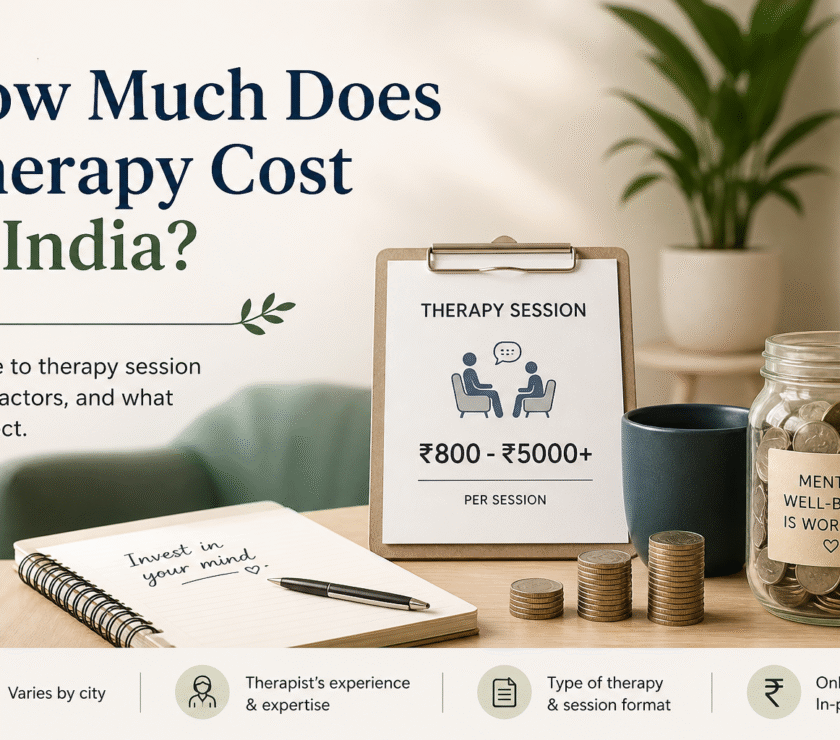
Aayina offers individual therapy sessions online across India, starting at ₹1000
Frequently Asked Questions
How long is a therapy session in India?
Most therapy sessions in India are 50–60 minutes long. At Aayina, all individual sessions are 50 minutes, held online or in-person.
What should I talk about in my first therapy session?
Anything that feels present for you. You don’t need a prepared topic. Many people start by describing what brought them to therapy — a feeling, a situation, or a general sense that something needs attention.
Is it normal to cry in a therapy session?
Completely. Some people cry, some don’t. Some feel calm, some feel relief. There is no correct emotional response, and nothing you feel in a session is wrong.
How many therapy sessions will I need?
This varies by person and by what you’re working on. Some people find value in just a few sessions. Others choose longer-term work. At Aayina, there is no minimum commitment — you can start with a single trial session at ₹1000.
Is online therapy as effective as in-person therapy in India?
Research consistently shows online therapy is as effective as in-person therapy for most concerns, including anxiety, stress, and life transitions. The most important factor is the quality of the therapeutic relationship, not the format.
Ready to experience it for yourself?
Aayina offers individual therapy sessions online across India, starting at ₹1,200. No long-term commitment — book a free 15-minute discovery call first, or go straight to a single session at your own pace.
Book your free discovery call →